*Note: this piece was originally published in The Mint Magazine.
It’s a cool spring day in Beijing. Magpies, starlings, and other local birds fill the air with song while the peonies and lotus flowers have begun blooming into captivating shades of pink, lavender, and blue. As a grad student at one of the city’s many universities, I decide to do the responsible thing and shirk my scholarly duties in favor of taking in the sights and sounds of this ancient capital on such a beautiful day.
Walking out of my dorm, I stroll over to a collection of dockless shared bikes painted bright yellow, the signature color of Chinese e-commerce giant, Meituan. I pick a bike, scan its QR code, and ride off campus with no particular destination in mind, dodging a sea of commuters on shared bikes and electric scooters in the designated non-car lane.
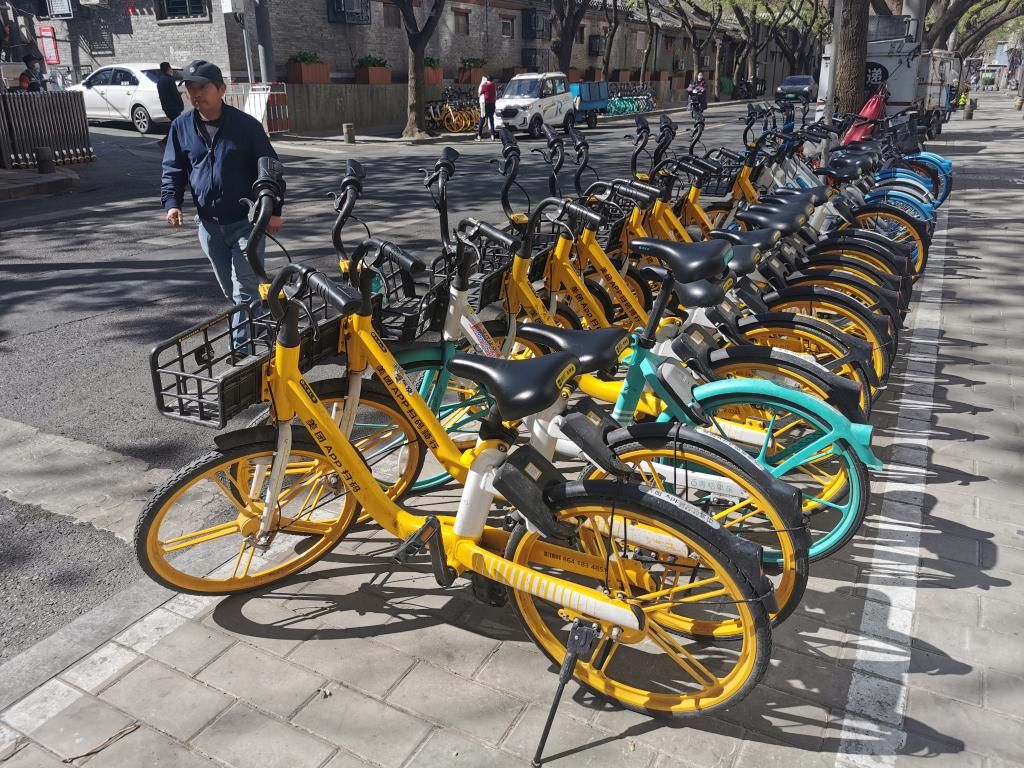
In the separate bus lane, Beijing’s nearly all-electric bus fleet ferries passengers to iconic destinations like the Summer Palace and the Forbidden City, while in the car lane, hundreds of electric vehicles (EVs), with their green license plates, speed along. After I’ve had my fill of biking, I throw up the kickstand on a nearby sidewalk, tell the app my ride is over, and scan another QR code to order and purchase a noodle dish from a local restaurant without even speaking to a server.
China has been at the forefront of global climate change adaptation and mitigation efforts at least since President Xi Jinping assumed office a decade ago. And it has already outperformed the US in a number of critical metrics.
Growing up in the US, I never imagined that daily life in China could be so high-tech and low-carbon, largely because the image of China presented to me was that of a nation that polluted its skies and waterways with reckless abandon, all to produce cheap exports for consumers, like myself, in the “developed” world. Unfortunately, it’s an image that persists to this day (see box: US Narratives and Their Consequences). Indeed, when addressing climate change at all, America’s conservative pundits and politicians condemn even the most meagre displays of climate action by liberal administrations in Washington as imposing an unfair burden on Americans, arguing that since China is the world’s largest polluter, it should naturally be China footing the bill.
US Narratives and Their Consequences
As tends to occur whenever China is mentioned in American corporate media outlets or elite politics, Beijing’s climate policy is discussed in a very reductive and simplistic way that’s at best misleading and at worst actively harmful to bilateral relations. For instance, in 1997, Democrats and Republicans unanimously passed the Byrd-Hagel Resolution by a 95 – 0 margin to prohibit Washington from joining the Kyoto Protocol, since the treaty didn’t require GHG reductions from developing economies like China, and in 2001, President George W. Bush clarified his opposition to the Protocol under the pretext that “it exempts 80 percent of the world, including major population centers such as China and India, from compliance, and would cause serious harm to the US economy.”
Just this July, the third most powerful Republican in the Senate and ranking member of its Energy and Natural Resources Committee, John Barrasso, penned an op-ed for Fox News wherein he alleged that Beijing is “playing Biden officials for suckers” and duping them with “deceitful promises,” just like they were fooled by “China’s big COVID-19 lie.” In the same piece, Barrasso paradoxically argues that Beijing is both supplying massive amounts of renewable energy inputs like solar panels and wind turbines to achieve “global domination,” while also “growing its economy with no regard to emissions,” unlike the hapless officials of the Biden administration.
These hysterical narratives consistently cast China, the Communist Party, and the Chinese people at large, as conniving deceivers aiming to manipulate foolish Americans into ruining their country while Beijing takes over the globe. Consciously or not, this worldview is also informed by America’s historic racist portrayals of Asian peoples as a “Yellow Peril” threatening the nation and the dominance of the white race, resulting in an unprecedented surge of anti-Asian violence and hatred across the country, even into the supposedly China friendly Biden administration.
In reality, China has been at the forefront of global climate change adaptation and mitigation efforts at least since President Xi Jinping assumed office a decade ago. And it has already outperformed the US in several critical metrics. For instance, China’s 393GW of installed solar power is more than triple that installed in the US (see graph: Installed solar energy capacity). And it accounts for well over a third of the world’s installed capacity, making Chinese companies the dominant producers of solar panels by far. At the same time, Chinese EV makers like BYD, Geely, and XPeng collectively outproduce Tesla in their domestic market and have already set up shop in foreign markets including Brazil, the Netherlands, and India, making China the global center for EVs (see box: The growth of China’s EV sector).
Meanwhile, Chinese energy firms like CATL are securing the supplies of lithium and other metals necessary to produce EV at mass scale. These concrete changes on the ground have been accompanied by an equally significant shift in the Chinese Communist Party’s rhetoric. This was most visible in the campaign to build an “ecological civilization” and President Xi’s “dual carbon” pledge at the 2020 UN General Assembly, in which he promised the world that China would achieve peak emissions by 2030 and become carbon neutral before 2060.
The Growth of China’s EV Sector
While the American EV maker, Tesla, and its eccentric owner, Elon Musk, capture media headlines, China has quickly and quietly become the world leader in producing EVs. It shifted at least 6.8m units in 2022, when the US only managed to sell 800,000. China sold well over 500,000 units in mainland China during this past May. This breakneck production pace means China has produced more than half of all EVs on the road today, and contrary to orthodox economic thinking, the driving force behind this rapid development has been well-designed state intervention rather than unfettered free markets.
Beginning in 2001, EVs were targeted as a focus area for research in the Five-Year Plan which guides the general path of China’s economic development. China looked to its producers to out-innovate legacy automakers from Japan, the US, and Germany in the future of transport, instead of trying to outcompete them in making traditional, petrol-powered vehicles. From 2009 to 2022, the Chinese state poured some $29bn into subsidies, tax credits, and other preferential policies to incentivize consumers to buy EVs, while handing out generous procurement contracts for EV producers.
What’s more, consumers buying EVs receive more favorable treatment in the infamous license plate lottery system practiced in big cities like Beijing, instead of waiting for years to have their name drawn and spending hundreds, or even thousands, of dollars on the black market, as consumers buying traditional vehicles must do. In 2019, for instance, it was estimated that the Chinese capital had around 2,600 applicants for every petrol-powered vehicle license, regularly leaving motorists waiting as long as five years without success. Instead of playing the odds, some Beijingers make their own luck by “renting” licenses from current owners or paying specialized agencies over $20,000 to arrange sham marriages to current license holders, transfer ownership of the coveted plates, and then file for divorce.
Despite party pronouncements, however, ecological protection and sustainable development have not always been its primary goals, and there are still serious structural obstacles that must be addressed if Beijing intends to make good on its ambitious climate goals. In fact, the party’s myopic focus since the era of Deng Xiaoping on economic development as measured by gross domestic product has wrought havoc on China’s environment and public health for decades. This is most notably through air pollution which continues killing millions of Chinese every year, and the degradation of major river systems including the Yangtze and Huaihe, which has rendered long segments of their waters unfit for human consumption and rendered the Yangtze’s baiji dolphin extinct along with other species.
While top officials in Beijing did want stricter enforcement of environmental protections, there’s an old Chinese proverb that “heaven is high, and the emperor is far away,” that is reflected in the lax attitude of many provincial cadre who were incentivized to prioritize the rapid economic development of their localities over the environment. Indeed, it was only after Chinese citizens and civil society made increasingly vocal criticisms of this wanton disregard for the environment that leadership in Beijing could leverage public anger to enforce stronger regulations and eventually include environmental protection alongside economic development in Party promotion criteria.
For instance, in June of 2007, public demonstrations against the construction of a chemical plant in Xiamen drew thousands of angry citizens and resulted in the project being cancelled following intervention by the central government. In 2013, a top official of the Chinese Society for Environmental Sciences estimated that the number of environmental protests had increased by nearly 30% every year since 1996.

Currently, China’s biggest ecological threat is its addiction to coal, with more than half of the nation’s energy coming from the domestically-abundant fossil fuel and hundreds of gigawatts in new coal projects being permitted every year, despite the Party’s promises to phase it down in the coming years. The coal issue is a reflection of Beijing’s growing national security concerns to reduce dependence on foreign suppliers as well as the complex center-local dynamics.
There are no shortages of opportunities for Washington and Beijing to cooperate in their sustainable transitions.
Meanwhile, as China charts a course towards sustainability that’s simultaneously promising and contradictory, lobbyists and politicians in Washington continue to funnel tens of billions of dollars in subsidies into the fossil fuel industry, while the Supreme Court whittles away what little capacity the Environmental Protection Agency has to confront climate change. All that said, however, American policymakers, specifically those of the Democratic stripe, deserve at least partial credit for the climate-related provisions of the Inflation Reduction Act, which, if actually implemented, could reduce the country’s emissions by up to 44% relative to 2005 levels by 2030, putting it well on track to meet its national determined contribution.
There are, however, no shortages of opportunities for Washington and Beijing to cooperate in their sustainable transitions. China’s heavy reliance on coal for electricity production reduces the real emissions’ reductions from rapid EV adoption. And phasing down coal will inevitably leave millions of Chinese workers unemployed in the nation’s poorer inland provinces like Shanxi, where I did some research earlier this year.

Local officials and academics highlighted the province’s efforts towards promoting sustainability. These include the designation of “model cities” incorporating more than 50% renewable energy and the establishment of a green business incubator within Shanxi University. The incubator has, so far, drawn more than 50 firms from across the province and yielded successful products like building materials made of coal by-products. However, Chinese leaders realize that much larger efforts will be needed to facilitate the transition of highly extractive provinces like Shanxi. To that end they would welcome US knowledge and experience such as how several coal-dependent counties within Appalachia – which spans more than 300km2 in the eastern US from New York to Mississippi – have managed to transition towards less extractive economies (see box: Successful Transitions in Coal Country). In return, China could help develop the US solar grid, accelerate EV adoption, and introduce more efficient bike-share systems into major cities.
Successful Transitions in Coal Country
As the heartland of American coal production and one of the poorest regions in the country, the energy transition in Appalachia – a region crossing 13 states east of the Mississippi River – sits at the intersection of both the climate crisis and social justice, much like Shanxi and other coal dependent provinces in China.
In general, the region’s transition performance has been relatively lackluster, but a recent report by Ohio State University highlights how four of more than 400 counties across the region have managed to kick the coal habit for good. According to the report’s authors, each of these few counties followed its own path to quitting coal, but they all tapped into unique local assets like universities, tourism, natural amenities, and proximity to highways that enabled them to avoid the kind of depopulation that has wrecked many neighboring coal-dependent Appalachian communities. The concluding remarks of the report offer several policy recommendations that could be applicable in the Chinese context including “buyouts” for miners; tax subsidies to coal-dependent local governments; and establishing a higher-level government agency explicitly tasked with supporting the transition from coal, like the Appalachian Regional Commission in the US.
However, geopolitical headwinds are blowing in the opposite direction. Both countries have temporarily suspended climate dialogues in the wake of an ill-advised trip to Taiwan by former House Speaker, Nancy Pelosi. And the US has banned imports of Chinese solar panels on alleged human rights abuses. Most recently China has limited exports of its uniquely abundant metals needed to build EVs. There have been some promising signs, including the recent meeting between the top climate envoys of both countries, but to ensure long-term progress, both sides need to ensure that climate is off limits from their escalating rivalry. To paraphrase the wise words of one Chinese climate expert: it’s fine for the US and China to compete on the world stage, but no one wins anything if that stage is destroyed in the process.
 Menu
Menu 
Leave a comment